
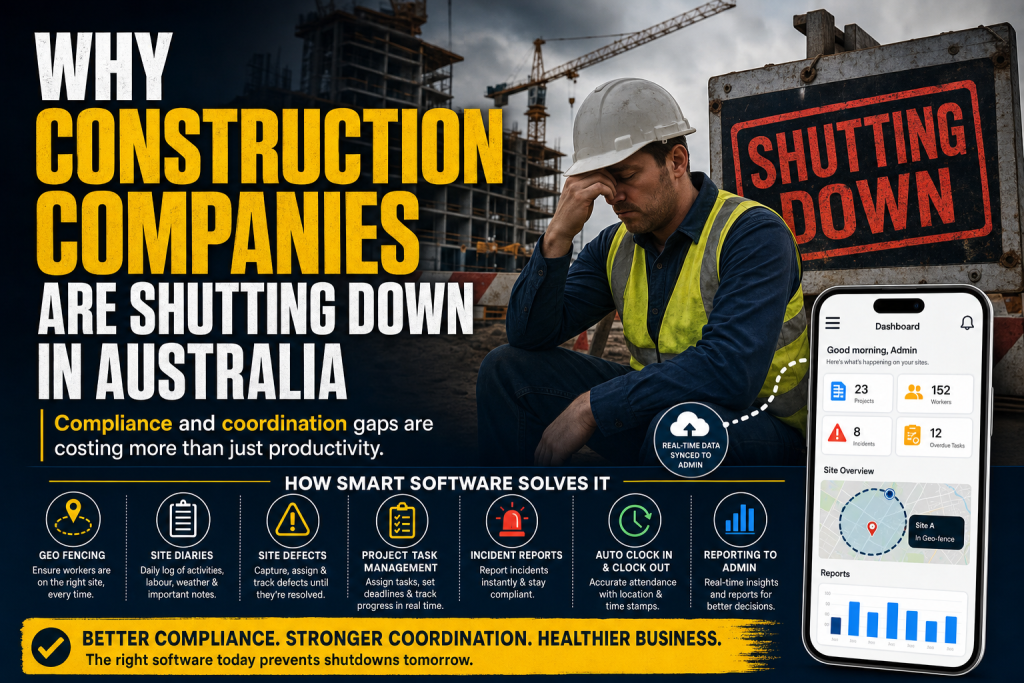
Why Construction Companies Are Shutting Down in Australia
In recent years, Australia’s construction industry has faced significant challenges, resulting in a concerning number of companies shutting down. This trend raises questions about the industry’s sustainability and management practices. A closer look reveals that compliance and coordination issues between employees and administrative staff are central to many of these closures. Fortunately, technology offers promising solutions to these problems. This article examines the primary challenges faced by construction companies and explores how innovative software can mitigate these issues.
Understanding the Challenges
Compliance and Coordination Issues
Compliance with regulations is crucial in the construction industry. Companies must adhere to numerous laws and standards related to safety, environmental impact, and labor rights. However, the complexity of these regulations often leads to miscommunication and mismanagement. Administrative staff may struggle to keep up with changing laws, while on-site employees might be unaware of the latest requirements. This disconnect can lead to fines, project delays, and ultimately, company shutdowns.
Coordination between various teams is equally important. Effective communication between on-site workers and administrative staff ensures that projects run smoothly. However, this coordination is often lacking. Misaligned objectives, unclear communication channels, and inefficient task management can create bottlenecks and reduce productivity.
The Role of Technology
Construction companies are increasingly turning to technology to address these challenges. Advanced software solutions can streamline operations, enhance communication, and improve compliance management. Here are some key features of such software:
– Geofencing: Using GPS to create virtual boundaries around a site, geofencing ensures employees are present during working hours and can automate clocking in and out. It helps manage attendance, reduce time theft, and improve payroll accuracy.
– Site Diaries: Digital site diaries enable workers to record daily activities, weather conditions, and any issues encountered. These records provide real-time insights into project progress and potential delays.
– Site Defects Management: Software allows workers to report defects instantly, ensuring prompt attention and reducing the risk of compliance violations.
– Project Task Management: Task management tools enable better coordination between teams, allowing task assignment, progress tracking, and deadline setting to keep projects on schedule.
– Incident Reporting: Digital tools make it easier to report accidents or safety breaches, speeding up response times and ensuring compliance with safety regulations.
– Automated Reporting: Software can generate detailed reports on project progress, compliance status, and financial performance, aiding informed decision-making.
Case Study: A Success Story
Consider a mid-sized construction company in Sydney that struggled with compliance issues and project delays. By implementing comprehensive construction management software, the company streamlined operations significantly. Geofencing ensured accurate timekeeping, while digital site diaries provided real-time updates. As a result, the company saw a 20% increase in productivity and a significant reduction in compliance-related fines.
Practical Tips for Implementation
1. Assess Your Needs: Before selecting software, assess your company’s specific needs, considering project size, employee numbers, and compliance complexity.
2. Choose the Right Software: Seek software with features relevant to your needs, ensuring it is user-friendly and compatible with existing systems.
3. Train Your Team: Implementing new technology requires training. Ensure both on-site workers and administrative staff understand how to use the software effectively.
4. Monitor and Adjust: Regularly review the software’s impact, and be willing to make adjustments to optimize use and address challenges.
The Future Outlook
As construction companies in Australia continue to face challenges, technology adoption will likely become increasingly important. The integration of artificial intelligence and machine learning could enhance construction management software, providing more precise insights and predictive analytics.
The rise of smart construction sites, where IoT devices and sensors monitor conditions in real-time, could revolutionize the industry. These advancements promise improved safety, efficiency, and compliance, enabling companies to thrive in a competitive market.
Risks and Considerations
While technology offers numerous benefits, potential risks exist. Data security is a significant concern, as construction companies handle sensitive information. Ensuring robust cybersecurity measures is crucial to protect against data breaches.
The cost of implementing new software can be a barrier for some companies. It’s important to consider the potential return on investment against initial expenses. Many software providers offer scalable solutions, allowing companies to start with basic features and expand as needed.
Conclusion
The closure of construction companies in Australia highlights the pressing need for improved compliance and coordination. By leveraging advanced software solutions, companies can address these challenges effectively. Geofencing, digital site diaries, defect management, and automated reporting are a few tools available to enhance operations and ensure compliance. With careful planning and implementation, construction companies can not only survive but thrive in the face of industry challenges. As technology advances, the future holds promising opportunities for those willing to embrace change.